In Defense of White: The Pale Vegetables Pulling Secret Weight
Quick Answer: “Eat the rainbow” accidentally benched some of the most nutritionally interesting vegetables there are. Garlic and onions work through colorless sulfur compounds rather than pigments. Mushrooms bring beta-glucans, B vitamins, and are the only produce that makes vitamin D when exposed to sunlight. Cauliflower is cruciferous royalty in a beige coat. The fix is one word: eat the rainbow plus white.
The rainbow rule is a genuinely good heuristic. Different pigments correspond to different families of plant compounds, so eating across the color spectrum tends to get you a broader range of them.
It has one blind spot, and the blind spot happens to season most of what’s on your plate.

Why Did the Rainbow Rule Miss White Vegetables?
Because it uses pigment as a proxy for phytonutrients, and some of the most studied plant compounds happen to be colorless.
Anthocyanins are purple. Carotenoids are orange. Lycopene is red. The rule works because those pigments are the compounds of interest — you can see the nutrition.
Organosulfur compounds are colorless. So are glucosinolates. So are beta-glucans. A vegetable can be packed with them and look like nothing much at all.
The color heuristic was never claiming that white vegetables lack value. It just had no way to signal them, and over time “eat the rainbow” quietly got heard as “avoid beige.”
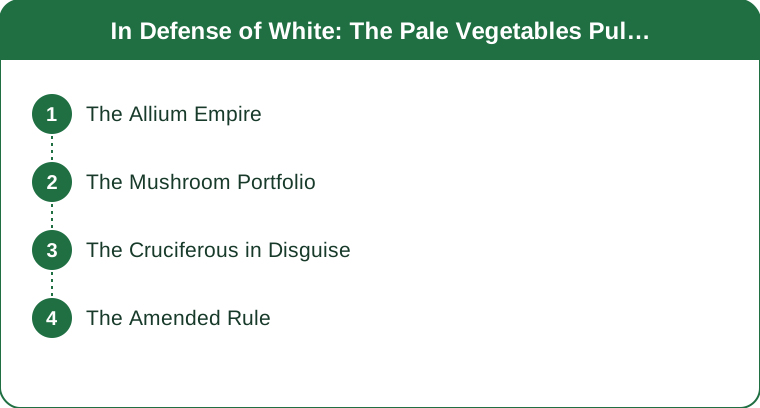
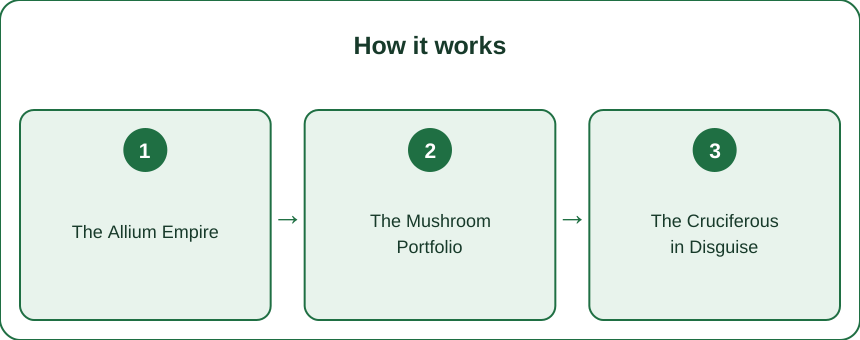
What Makes Garlic and Onions Worth Eating?
Sulfur compounds, not pigment. When you crush or chop garlic, an enzyme converts alliin into allicin, along with a family of related organosulfur compounds.
Garlic is one of the most-studied foods in the nutrition literature, with a long history in traditional medicine across essentially every culture that had access to it. Research has looked at effects on blood pressure, cholesterol, and immune function, and while results vary in strength across studies, it’s a genuinely well-investigated food rather than a folk claim.
Onions, alongside their own sulfur compounds, are a leading dietary source of quercetin — a flavonoid concentrated particularly in the outer layers and in red varieties.
Practical notes:
- Crush or chop garlic and let it sit for about 10 minutes before cooking. This allows the allicin-forming reaction to complete before heat deactivates the enzyme
- Heat degrades some of these compounds, so raw or lightly cooked garlic retains more than long-roasted
- Don’t peel onions more than necessary — the outer layers hold the most quercetin
Your arteries were never checking the color chart.
Why Are Mushrooms Worth a Weekly Slot?
Three reasons, and one of them is genuinely unusual.
Beta-glucans. A type of soluble fibre found in mushroom cell walls, studied for effects on immune function and cholesterol.
B vitamins. Mushrooms are a decent source of riboflavin, niacin, and pantothenic acid — relatively unusual among vegetables.
Vitamin D, on request. This is the party trick. Mushrooms contain ergosterol, which converts to vitamin D2 when exposed to ultraviolet light — the same way skin does. Put sliced mushrooms gill-side up in direct sunlight for an hour or two and their vitamin D content rises substantially. It sounds like folklore and it’s a documented, reproducible effect; some commercial producers now UV-treat mushrooms deliberately and label them as such.
They’re also the best source of culinary umami in the vegetable aisle, which makes them useful well beyond their nutrition — a handful of dried porcini adds savoury depth to almost anything.

Is Cauliflower as Good as Broccoli?
It’s the same family, and the family is the point.
Cauliflower is a cruciferous vegetable — the same group as broccoli, kale, cabbage, and Brussels sprouts. That group is defined by glucosinolates, which convert to compounds including sulforaphane when the vegetable is chopped or chewed.
Broccoli gets the headlines and typically contains more sulforaphane, particularly in sprouted form. But cauliflower carries the same cruciferous credentials, and it happens to be far more versatile — the rice, the steak, the roast, the mash. The renaissance in cauliflower cooking over the last decade means it’s easier than ever to eat a lot of it.
The cooking note that matters: boiling leaches glucosinolates into the water and heat degrades the enzyme that converts them. Steaming lightly, roasting, or eating some raw preserves considerably more than boiling does.
The white team’s third heavyweight was cruciferous royalty in a beige coat the entire time.
Myth vs Fact: White Vegetables
Myth: White foods are nutritionally empty. Fact: That claim comes from refined white foods — white bread, white sugar, white rice. It got over-applied to white vegetables, which are an entirely different category.
Myth: Potatoes don’t count as a vegetable. Fact: A potato with skin is a decent source of potassium, vitamin C, and fibre. What people object to is usually the preparation, not the potato.
Myth: Garlic supplements work the same as fresh garlic. Fact: Allicin is unstable, and supplement formulations vary enormously in what they actually deliver. Fresh crushed garlic is the better-evidenced route, and considerably cheaper.
Myth: Onions and garlic are just flavourings, not vegetables. Fact: They’re the base of savoury cooking in most world cuisines, and eaten daily in meaningful quantities. Flavouring and vegetable aren’t mutually exclusive.
Myth: Mushrooms have “no nutritional value.” Fact: Widely repeated and simply wrong. Low in calories is not the same as low in nutrients.
What’s the Amended Rule?
Eat the rainbow, plus white. Five color families plus the colorless one.
In practice, this is less of a change than it sounds, because the white team is already in most traditional cooking:
- Garlic and onion bases in most savoury dishes. Already traditional — now intentional
- Mushrooms at least weekly. Sunbathe them if you remember; it costs nothing
- Cauliflower regularly, roasted or riced rather than boiled to submission
- Leeks, shallots, fennel, parsnip, turnip, white cabbage — the wider white bench
None of this displaces colored vegetables. The pigmented compounds are real and worth eating for. This is an addition to the team sheet, not a substitution.
A general caveat worth stating: individual foods don’t do dramatic things on their own, and most of what’s known about these compounds comes from studies where the effects are modest and the overall dietary pattern matters far more than any single ingredient. If you’re on blood-thinning medication, garlic in supplement doses is worth mentioning to your doctor, and anyone with a diagnosed digestive condition like IBS may find alliums specifically problematic — talk to a dietitian rather than pushing through.
Frequently Asked Questions
Does cooking destroy the benefits of garlic?
It reduces them, but doesn’t eliminate them. The practical workaround is to crush or chop the garlic and let it sit for around 10 minutes before it hits heat — that gives the enzyme time to produce allicin before cooking deactivates it. Adding some garlic at the end of cooking rather than only at the start also helps.
How long do mushrooms need in the sun to make vitamin D?
Studies have found meaningful increases from as little as 15 minutes to two hours of direct midday sun, with sliced mushrooms gill-side up producing the biggest rise because more surface area is exposed. It works best in summer sun and much less well through glass, since window glass blocks most UVB.
Are white potatoes actually healthy?
They’re a reasonable source of potassium, vitamin C, and — with the skin on — fibre, and they’re a dietary staple across much of the world. The health concerns usually attached to potatoes are really about preparation (deep frying, large amounts of added fat and salt) and about eating them to the exclusion of other vegetables. Boiled, baked, or roasted with the skin, they’re a perfectly reasonable part of a varied diet.
TL;DR:
- The rainbow rule uses pigment as a proxy, and some key plant compounds are colorless
- Garlic and onions run on sulfur compounds — crush garlic and wait 10 minutes before cooking
- Mushrooms bring beta-glucans, B vitamins, and make vitamin D in sunlight (gills up, 1–2 hours)
- Cauliflower is cruciferous with the same glucosinolate credentials as broccoli — steam or roast, don’t boil
- Also on the bench: leeks, shallots, fennel, parsnip, turnip, white cabbage
- This is an addition, not a substitution — colored vegetables still earn their place
- Overall dietary pattern matters far more than any single ingredient
Read the full eat the rainbow guide for the colored half of the team. The heuristic was good — it just had one blind spot, and the blind spot seasons everything else on the plate.
Keep Reading
This article is for general informational purposes only and is not medical advice. Always consult a qualified health professional for guidance specific to you.