Why Your Smoothie Turns Brown — and What It Costs You
Quick Answer: Browning is enzymatic oxidation — enzymes released when you break cell walls react with oxygen and turn phenolic compounds into brown pigments. It signals some genuine loss of vitamin C and certain polyphenols, but most fiber, minerals, and carotenoids survive fine. Acid, cold, and less air slow it down substantially.
You make a smoothie that looks like a paint sample. You put it in the fridge for the afternoon, and by lunch it looks like something you found in a drain. The color change is not cosmetic — it is a reaction, and it is worth understanding what it does and does not cost you.
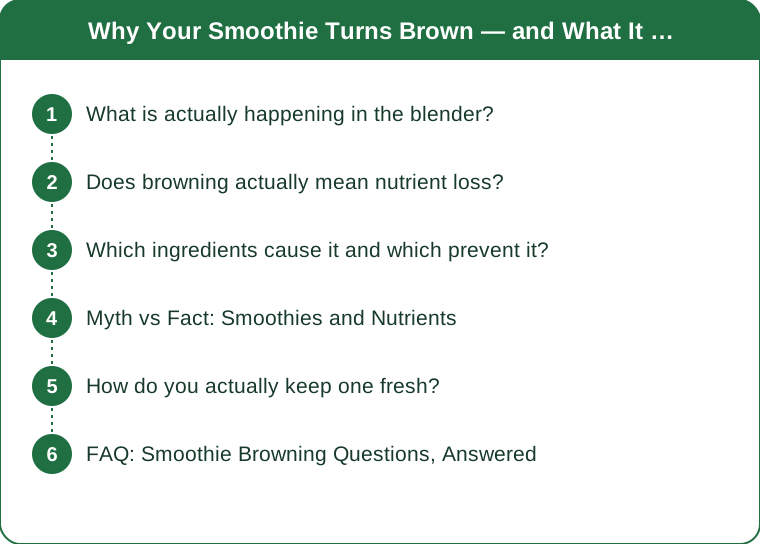
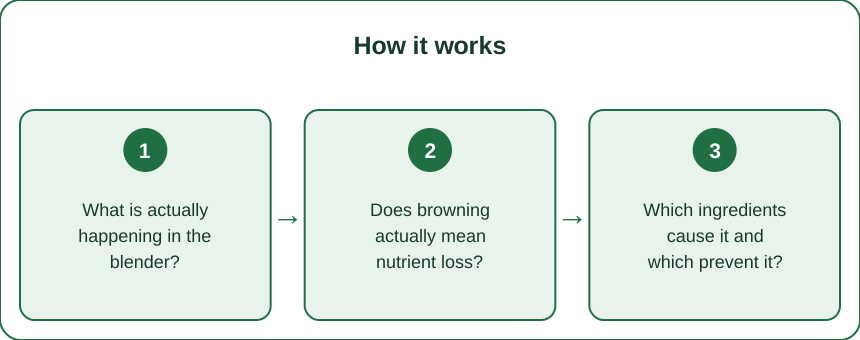
What is actually happening in the blender?
Cells are breaking and enzymes are meeting things they were kept away from.
In intact produce, enzymes and their substrates live in separate compartments inside the cell. Blending destroys those compartments entirely. The enzyme polyphenol oxidase meets phenolic compounds and oxygen simultaneously, and the reaction that follows converts those phenolics into quinones, which then polymerize into brown pigments called melanins.
This is the exact same reaction that browns a cut apple, a sliced avocado, and a bruised banana.
Three conditions have to be present, which is convenient because removing any one slows it down:
- The enzyme — which varies enormously by produce. Apples, bananas, pears, and avocados are high; citrus and berries are low
- Oxygen — which blending incorporates in large quantities as foam
- A favorable pH — the enzyme works best in a moderately acidic to neutral range and slows sharply when it gets acidic enough
Blending is close to a worst-case scenario for all three: maximum cell disruption, maximum air incorporation, and usually a neutral pH.
Does browning actually mean nutrient loss?
Some, and considerably less than the visual suggests.
Genuinely affected:
- Vitamin C is the most vulnerable nutrient in a blended smoothie. It is water-soluble, heat-sensitive, and oxidizes readily. Losses accumulate over hours of storage
- Some polyphenols are consumed in the browning reaction itself, since they are the substrate
- Folate degrades with oxygen exposure and time, though more slowly
Largely unaffected:
- Fiber — completely stable. Blending does not remove it, contrary to a persistent myth
- Minerals — potassium, magnesium, calcium do not oxidize away
- Carotenoids — the orange, red, and yellow pigments in carrots, mango, and sweet potato are fat-soluble and relatively stable. A smoothie can turn brown on the surface while its carotenoid content is essentially intact
- Protein and healthy fats from yogurt, nut butter, or seeds
So the honest summary: a browned smoothie is a smoothie with less vitamin C and some altered polyphenols, and otherwise most of what you put in it. Drinking it four hours later is worth doing; it is just not as good as drinking it immediately.
Which ingredients cause it and which prevent it?
The composition of your smoothie determines almost everything about how fast it turns.
High browning potential:
- Bananas — the most common culprit by a wide margin, and the reason so many smoothies go grey
- Apples and pears
- Avocado
- Peaches and nectarines
Low browning potential:
- Berries of all kinds — naturally acidic and rich in stable anthocyanin pigments
- Citrus — highly acidic, which suppresses the enzyme directly
- Pineapple and mango — acidic
- Dairy and plant milks, which dilute and buffer
Actively protective:
- Lemon or lime juice. The single most effective addition. It lowers pH into the range where the enzyme works poorly, and vitamin C acts as a sacrificial antioxidant. A tablespoon changes the outcome dramatically
- Frozen fruit, which lowers the temperature and slows the reaction rate substantially
- Vitamin C powder if you do not want the flavor of citrus
The green smoothie exception: leafy greens turn a smoothie brown-green through a different route — chlorophyll degrades in acid, so the very lemon juice that prevents enzymatic browning makes green smoothies go khaki faster. If your priority is a bright green color, use less acid and drink it fresh.
Myth vs Fact: Smoothies and Nutrients
Myth: Blending destroys the fiber. Fact: Blending breaks fiber into smaller pieces but does not remove it. All of it is still in the glass. Juicing removes it; blending does not. The particle size does change how quickly sugars are absorbed somewhat, which is a real if modest effect.
Myth: A brown smoothie is spoiled. Fact: Browning is oxidation, not microbial spoilage. A refrigerated smoothie is generally fine for about 24 hours regardless of color. Judge safety by smell and time, not by color.
Myth: Blending destroys nutrients from the heat. Fact: Blending does generate some heat, but in a normal 60-second blend the temperature rise is small. Oxygen exposure and time do far more damage than the friction does.
Myth: The nutrients are gone within minutes. Fact: Vitamin C loss is measurable over hours, not minutes. A smoothie drunk within an hour has lost very little of anything. The dramatic-sounding losses come from overnight storage in an air-filled container.
How do you actually keep one fresh?
Five techniques, roughly in order of effect:
- Fill the container completely. Headspace is oxygen, and oxygen is one of the three required ingredients. A jar filled to the brim with the lid on browns dramatically more slowly than a half-full one
- Add acid. A squeeze of lemon or lime, or a base of citrus or pineapple. This is the highest-impact ingredient change
- Keep it cold. Blend with frozen fruit rather than fresh plus ice, and refrigerate immediately. Reaction rates roughly halve for every 10°C drop
- Blend less. Longer blending incorporates more air and disrupts more cells. Blend until smooth and stop
- Choose the composition. A berry and citrus base browns far less than a banana and apple base, whatever else you do
For genuine make-ahead: freeze pre-portioned bags of ingredients rather than the finished smoothie. Blend in the morning from frozen and you get a fresh smoothie in ninety seconds with none of the storage losses. This is the approach that actually solves the problem rather than managing it.
And a seasonal note worth acting on now: late summer is peak season for the highest-antioxidant produce of the year — berries, stone fruit, tomatoes, peppers. Freezing them at peak ripeness right now preserves color and nutrients far better than buying them out of season in February, and frozen-at-peak reliably beats fresh-but-old on both counts.
FAQ: Smoothie Browning Questions, Answered
Is a browned smoothie still worth drinking?
Yes. You have lost some vitamin C and altered some polyphenols, and you still have all the fiber, minerals, carotenoids, protein, and fat. Drinking a slightly oxidized smoothie is considerably better than skipping it.
Why does my smoothie separate as well as brown?
Separation is a different process — it is simply density, with heavier particles settling and lighter ones rising. It says nothing about nutrient content and a shake fixes it. Fat and fiber content both reduce it.
Does a vacuum blender actually help?
Yes, meaningfully, and this is one of the rare cases where a gadget claim holds up. Removing air before blending limits the oxygen available for the reaction, and the resulting smoothie both looks and keeps noticeably better. Whether it justifies the price is a separate question — a full jar with lemon juice gets you most of the way for nothing.
TL;DR:
- Browning is enzymatic oxidation, needing enzyme, oxygen, and the right pH — remove any one and it slows
- You lose some vitamin C and polyphenols; fiber, minerals, and carotenoids survive intact
- Bananas, apples, and pears brown fast; berries and citrus resist it and protect the rest
- Fill the jar to the brim, add lemon, use frozen fruit, and blend less
- Freeze ingredient bags rather than finished smoothies, and freeze late-summer produce at peak now
The color is a real signal, just a milder one than it looks. A brown smoothie has lost something worth avoiding and kept nearly everything worth having.
Keep Reading
This article is for general informational purposes only and is not medical advice. Always consult a qualified health professional for guidance specific to you.