Why Kids Often Reject the Most Colorful Vegetables First — And What Actually Helps
Quick Answer: Kids often reject the most colorful vegetables first because bright color and bitterness are frequently linked in nature (a survival instinct against potentially toxic plants), meaning many of the most nutrient-dense colorful vegetables also carry the bitter compounds young palates are most sensitive to — repeated, low-pressure exposure over time, not just presentation, is what most reliably improves acceptance.
It’s not pickiness for its own sake — there’s a real sensory and evolutionary logic behind which vegetables get rejected most consistently.

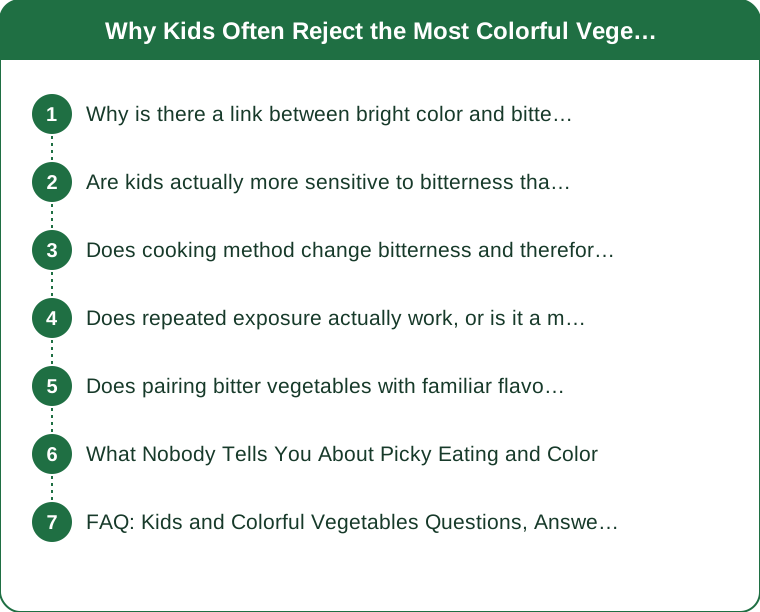
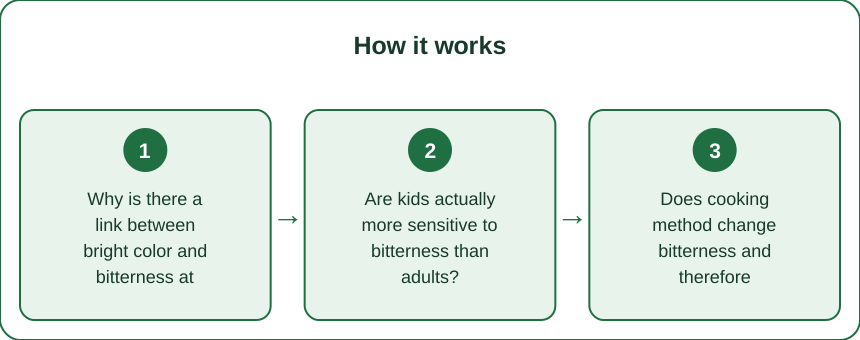
Why is there a link between bright color and bitterness at all?
Many of the plant compounds responsible for vivid color (like certain flavonoids and glucosinolates) are the same compounds responsible for bitter taste, and both tend to concentrate in the same vegetables — this isn’t a coincidence, it reflects the plant’s own chemical defense compounds, which happen to be both colorful and bitter-tasting.
Are kids actually more sensitive to bitterness than adults?
Yes, genuinely — children have more taste buds and a heightened bitterness sensitivity compared to adults, a trait that gradually decreases with age. This means a vegetable an adult finds mildly bitter can taste significantly more intense to a child, which is a real physiological difference, not just preference.
Does cooking method change bitterness and therefore acceptance?
Often significantly — roasting, which caramelizes natural sugars, tends to reduce perceived bitterness compared to steaming or boiling, which can concentrate or fully preserve bitter compounds. Trying the same vegetable across a few different cooking methods can reveal one that a picky eater tolerates much better than another.

Does repeated exposure actually work, or is it a myth?
It’s well-supported — research consistently shows acceptance of a new or disliked food often takes 8-15 exposures, far more than most parents attempt before giving up. Crucially, exposure doesn’t have to mean eating it each time — seeing, smelling, and touching the food repeatedly without pressure to eat it also builds familiarity that eventually supports acceptance.
Does pairing bitter vegetables with familiar flavors help?
Yes — pairing a bitter vegetable with a familiar, mildly sweet or fatty element (like a bit of cheese, a light glaze, or a dip) can offset the bitterness enough to ease a first taste, without needing to disguise or hide the vegetable entirely.
What Nobody Tells You About Picky Eating and Color
Pressuring a child to eat a rejected vegetable tends to backfire and reinforce the rejection long-term, according to feeding research — a low-pressure, repeated-exposure approach, even when progress feels frustratingly slow, produces better long-term acceptance than insisting on a bite at every meal.
FAQ: Kids and Colorful Vegetables Questions, Answered
Does blending vegetables into other foods count as meaningful exposure?
It can help with nutrient intake short-term, but it doesn’t build the taste familiarity needed for a child to eventually accept the vegetable in its recognizable form.
Is it normal for bitterness sensitivity to fade with age on its own?
Yes — many children naturally become more accepting of bitter vegetables through the pre-teen and teen years as taste bud density and sensitivity change.
Should parents avoid offering rejected vegetables to prevent mealtime stress?
No — continuing to offer, without pressure to eat, keeps the exposure count building even through periods of consistent refusal.
TL;DR:
- Bright color and bitterness are chemically linked in many vegetables, not a coincidence
- Kids have genuinely heightened bitterness sensitivity compared to adults
- Roasting tends to reduce perceived bitterness more than steaming or boiling
- Repeated low-pressure exposure, not a single presentation change, drives real acceptance over time
Keep offering the rejected vegetable without pressure to eat it — the exposure count matters more than any single meal’s outcome, even when progress feels slow.
Keep Reading
This article is for general informational purposes only and is not medical advice. Always consult a qualified health professional for guidance specific to you.