Why a Bag of Frozen Vegetables Can Have More Color-Nutrients Than 'Fresh' Produce
Quick Answer: Vegetables destined for freezing are typically picked at peak ripeness and frozen within hours, locking in phytonutrients at their highest point, while ‘fresh’ produce can spend days to weeks in transport and store shelves losing nutrients the whole time — meaning a frozen bag can genuinely out-nutrient a wilted fresh version of the same vegetable.
The ‘fresh is always better’ assumption skips over exactly how long that fresh produce sat around before reaching a plate.

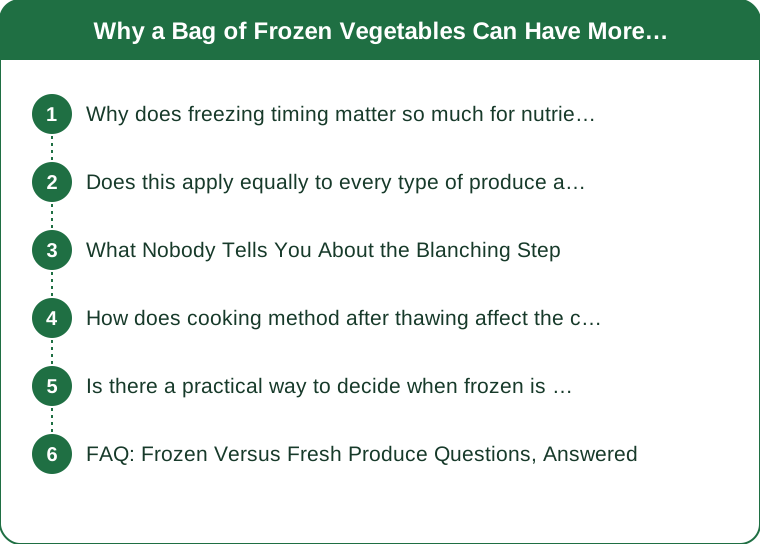
Why does freezing timing matter so much for nutrient retention?
Produce continues to lose water-soluble vitamins and some phytonutrients from the moment it’s harvested, through a process that accelerates with time, heat, and light exposure — freezing essentially halts that degradation process at whatever nutrient level existed at the moment of freezing. Because commercial freezing operations are built around picking at peak ripeness and processing within hours, the nutrient ‘snapshot’ they capture is often higher than what survives days of shipping, warehouse storage, and shelf time that fresh produce typically undergoes before it’s purchased and eaten.
Does this apply equally to every type of produce and every nutrient?
Not perfectly evenly — water-soluble vitamins like vitamin C and some B vitamins degrade fastest with time and are the ones where freezing’s speed advantage shows up most clearly, while fat-soluble nutrients and many phytonutrients like carotenoids are somewhat more stable during typical fresh storage windows. The size of the frozen advantage also depends heavily on how long the ‘fresh’ comparison produce actually sat before eating — a vegetable eaten within a day of harvest from a farmers market will usually beat its frozen counterpart, while one that traveled a long supply chain often won’t.
What Nobody Tells You About the Blanching Step
Most frozen vegetables are briefly blanched (quickly boiled or steamed) before freezing, and this step gets treated as a pure downside in casual nutrition talk, when the reality is more mixed. Blanching does cause some nutrient loss, particularly water-soluble vitamins leaching into the blanching water, but it also deactivates enzymes that would otherwise continue breaking down nutrients during frozen storage — without it, frozen produce would actually degrade faster in the freezer than it does. The net effect of blanch-then-freeze, compared to the full fresh supply chain, still usually favors the frozen product for many vegetables, but it’s genuinely a tradeoff rather than a free win, which most ‘frozen is always better’ claims skip over entirely.

How does cooking method after thawing affect the comparison?
This matters as much as the freezing question itself — a nutrient-dense frozen vegetable steamed briefly retains far more of its content than the same vegetable boiled for an extended time, since prolonged boiling leaches water-soluble nutrients into water that typically gets discarded. Quick methods (steaming, roasting, stir-frying) preserve more of whatever nutrient advantage frozen produce started with, meaning the freezing decision and the cooking decision compound rather than acting independently.
Is there a practical way to decide when frozen is the better choice?
A reasonable rule of thumb: if the fresh option was harvested locally and recently (a farmers market, a short regional supply chain, produce clearly in season), fresh likely retains an edge; if the fresh option has traveled a long distance or looks like it’s been sitting for a while, frozen is often the more nutrient-dense and more budget-friendly choice. For anyone whose vegetable intake fluctuates with what’s convenient, keeping frozen vegetables as a reliable baseline — rather than skipping vegetables entirely when fresh options look tired — is a meaningfully better outcome nutritionally.
FAQ: Frozen Versus Fresh Produce Questions, Answered
Does frozen produce lose nutrients the longer it sits in the freezer?
Slowly, yes, but the rate is far slower than fresh produce sitting at room temperature or refrigerated — most frozen vegetables retain the bulk of their nutrient content for many months, well beyond typical household storage timelines.
Is frozen fruit held to the same nutrient logic as frozen vegetables?
Generally yes — fruit destined for freezing is typically picked ripe and frozen quickly, following the same peak-nutrient-capture principle, making frozen berries in particular a commonly cited example of a frozen product that reliably matches or beats out-of-season fresh alternatives.
Should frozen and fresh produce just be combined in a normal diet rather than choosing one?
Yes, and that’s usually the most practical real-world approach — using fresh produce when it’s genuinely in season and locally available, and leaning on frozen as a reliable, nutrient-dense backup the rest of the time, covers both convenience and nutrient density better than a strict either-or approach.
TL;DR:
- Produce frozen quickly after peak-ripeness harvest can retain more nutrients than fresh produce that traveled and sat for days
- Water-soluble vitamins show the clearest frozen advantage; fat-soluble nutrients are more stable either way
- Blanching before freezing is a real tradeoff, not a pure downside — it prevents faster freezer degradation
- Quick cooking methods after thawing preserve more of whatever nutrient advantage frozen started with
- Locally sourced, recently harvested fresh produce still usually wins — the comparison depends on the fresh option’s actual age
Frozen vegetables aren’t a consolation prize — for a lot of real-world grocery timelines, they’re the more nutrient-dense choice.
Keep Reading
This article is for general informational purposes only and is not medical advice. Always consult a qualified health professional for guidance specific to you.