Why a Colorful Plate Can Still Be Nutritionally Unbalanced (Even When It Looks Perfect)
Quick Answer: Color variety tracks phytonutrient diversity well, but it doesn’t automatically account for protein, healthy fats, or specific micronutrients like B12 and iron that aren’t color-coded — a visually colorful plate can still be missing entire nutrient categories that don’t show up as a color at all.
You’ve built the habit of eating the rainbow, your plates look genuinely gorgeous, and yet something still feels off — you’re tired by mid-afternoon despite all that produce.

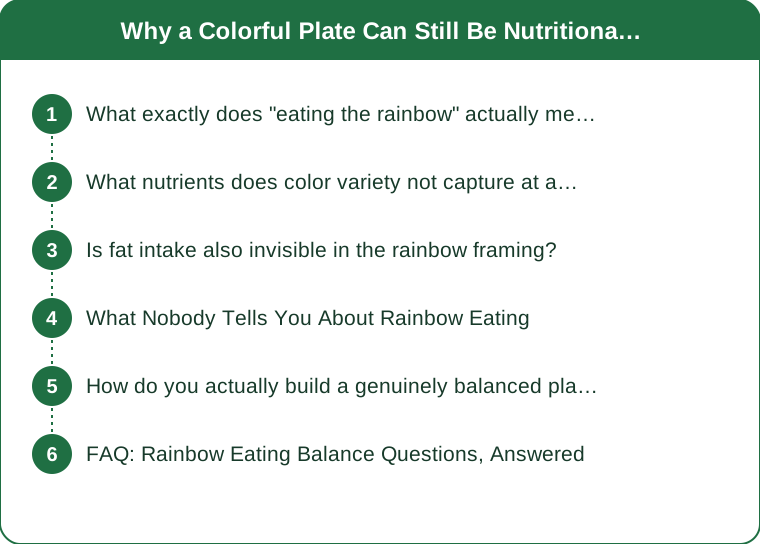
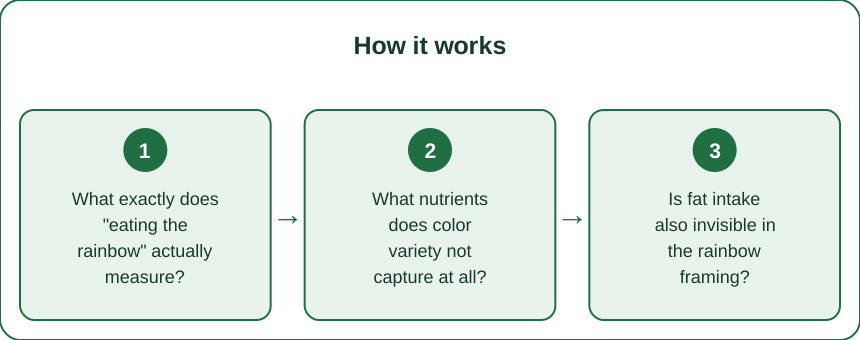
What exactly does “eating the rainbow” actually measure?
Color variety in produce is a proxy for phytonutrient diversity — different plant pigments (carotenoids, anthocyanins, chlorophyll) correlate with different antioxidant and micronutrient profiles. It’s a genuinely useful heuristic for plant nutrient variety specifically, but that’s a narrower claim than “complete nutrition,” which the color framing doesn’t actually promise.
What nutrients does color variety not capture at all?
Protein, iron, B12, omega-3 fats, and calcium aren’t meaningfully color-coded — a plate of purple cabbage, orange carrots, and green spinach can be beautifully diverse in phytonutrients while still being low in protein or missing B12 entirely if there’s no animal product or fortified source included.
This is the most common gap: people build gorgeous, genuinely nutrient-dense produce plates and then wonder why they’re fatigued, when the missing piece is protein or B12, not more colors.
Is fat intake also invisible in the rainbow framing?
Yes — healthy fats (avocado, olive oil, nuts) don’t register as a “color” in the same intuitive way, so a rainbow-focused plate can easily be too low in fat for satiety and for absorbing fat-soluble vitamins (A, D, E, K) that many of those colorful vegetables actually contain but need dietary fat present to absorb properly.

What Nobody Tells You About Rainbow Eating
Fat-soluble vitamin absorption depends on eating those colorful vegetables alongside some fat — carotenoids in carrots and leafy greens are significantly better absorbed with a source of fat in the same meal, so a completely fat-free colorful salad is actually less nutritionally effective than the same salad with a drizzle of olive oil.
Also underrated: frozen produce often retains comparable or even higher nutrient levels than fresh produce that’s traveled and sat for days, so color variety doesn’t require an expensive fresh-only approach to be nutritionally meaningful.
How do you actually build a genuinely balanced plate?
Use color variety as one layer, not the whole plan: aim for produce color diversity, then separately check that a protein source, a fat source, and (if needed) a fortified or animal-based B12 source are also present. Think of it as a checklist with color as just one line item, not the entire list.
FAQ: Rainbow Eating Balance Questions, Answered
Is eating the rainbow still a useful habit to keep?
Yes — it’s a genuinely effective way to build produce and phytonutrient variety, it just isn’t sufficient alone for total nutritional balance.
Do vegetarians need to worry about this gap more than others?
Somewhat — B12 in particular is essentially absent from plant foods, making it the most common gap for those building very plant-forward, color-focused plates without a fortified source or supplement.
Does cooking method affect whether colorful vegetables deliver their nutrients?
Yes, some — light cooking increases bioavailability of certain carotenoids (like in tomatoes and carrots) while reducing others (like vitamin C), so a mix of raw and lightly cooked produce covers more ground than either approach alone.
TL;DR:
- Color variety tracks phytonutrient diversity, not total nutritional completeness
- Protein, B12, iron, and healthy fats aren’t captured by the color framework at all
- Fat-soluble vitamins in colorful produce need dietary fat present to actually absorb
- Use color as one checklist item alongside protein and fat, not the whole plan
Keep Reading
This article is for general informational purposes only and is not medical advice. Always consult a qualified health professional for guidance specific to you.