Why a Colorful Plate Can Still Be Nutritionally Unbalanced
Quick Answer: Different colored produce corresponds to different phytonutrient families, but color variety alone doesn’t account for portion size, cooking method, or whether the meal also includes adequate protein, fiber, and healthy fats — meaning a visually colorful plate can still be low in overall nutritional balance if those other factors aren’t also in place, since color diversity is one piece of a larger nutrition picture, not the whole picture.
The plate looks like a produce aisle ad — reds, greens, purples, all present and accounted for. That visual variety is genuinely useful, but it’s not the same thing as a nutritionally complete meal.

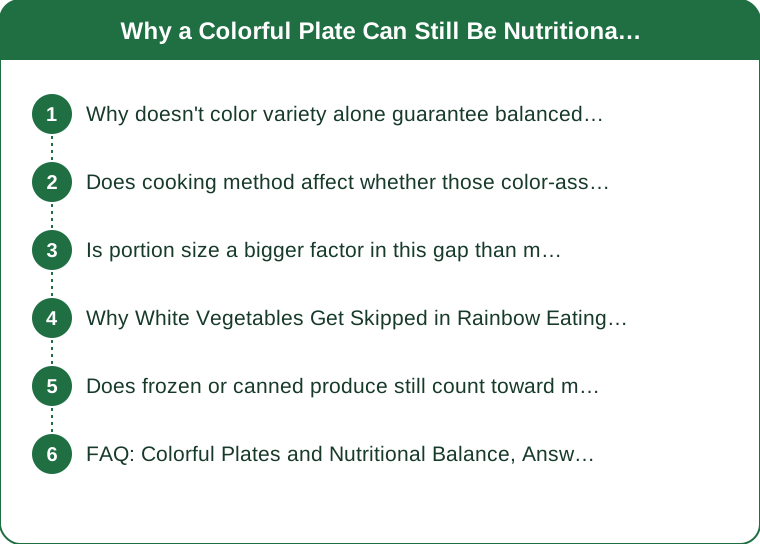
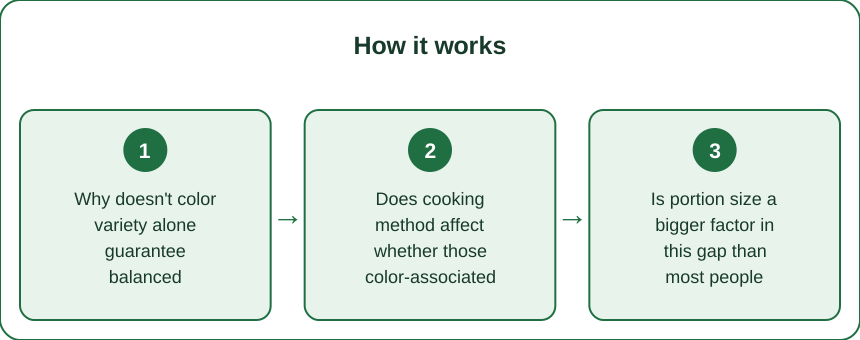
Why doesn’t color variety alone guarantee balanced nutrition?
Color variety specifically reflects phytonutrient and antioxidant diversity, which is genuinely valuable, but a meal can be colorful while still lacking adequate protein, healthy fats, or sufficient total calories and fiber to be nutritionally complete, meaning color diversity addresses one nutritional dimension without automatically covering the others a balanced meal needs.
Does cooking method affect whether those color-associated nutrients actually get absorbed?
Yes — some phytonutrients, like lycopene in tomatoes, become more bioavailable when cooked, while others, like vitamin C in some vegetables, degrade with heat, meaning the same colorful ingredients can deliver meaningfully different actual nutrient absorption depending on how they’re prepared, not just which colors are on the plate.
Is portion size a bigger factor in this gap than most people assume?
Often, yes — a plate can technically include five different colors of produce while each portion is small enough that the total nutrient contribution is modest, meaning a colorful plate with generous portions of two or three vegetables can sometimes provide more actual nutritional value than a technically more colorful plate with token amounts of many.

Why White Vegetables Get Skipped in Rainbow Eating — and Why That’s a Mistake
White vegetables like cauliflower, onions, and garlic contain their own valuable compounds (like allicin and glucosinolates) that don’t fit neatly into the ‘eat the rainbow’ color framework, and skipping them in favor of only the visibly bright colors means missing out on a nutritionally meaningful category that the color-counting approach inadvertently deprioritizes.
Does frozen or canned produce still count toward meaningful color variety and nutrition?
Yes, and often more than assumed — frozen produce is typically processed at peak ripeness and retains comparable or sometimes higher nutrient levels than fresh produce that’s traveled and sat for days, meaning frozen colorful vegetables are a legitimate and sometimes nutritionally superior way to build a genuinely balanced colorful plate.
FAQ: Colorful Plates and Nutritional Balance, Answered
What should be added to a colorful produce-heavy plate to make it more nutritionally complete?
Ensuring the meal also includes a solid protein source and some healthy fat rounds out what color variety alone doesn’t provide, since protein and fat both play roles color-focused eating doesn’t directly address.
Is there a simpler way to think about nutrition than counting colors on a plate?
Focusing on including a protein source, a fat source, and a mix of vegetables (colorful or not) at most meals is a more complete practical framework than color-counting alone, while still keeping the genuine benefits of produce variety.
Does eating the same few colorful vegetables repeatedly limit the nutritional benefit compared to true variety?
Some repetition is fine, but rotating through different specific vegetables even within the same color family (different leafy greens, for instance) provides a broader range of specific phytonutrients than relying on the same one or two vegetables per color repeatedly.
TL;DR:
- Color variety reflects phytonutrient diversity but doesn’t by itself guarantee protein, fat, or fiber balance
- Cooking method changes how much of a colorful food’s nutrients actually get absorbed
- Portion size matters as much as color count — small amounts of many colors can add up to less than expected
- White vegetables offer valuable nutrients the color-counting framework tends to overlook
A colorful plate is a genuinely good habit, but pairing that color variety with adequate protein, fat, and reasonable portions is what actually makes a meal nutritionally balanced, not the color count on its own.
Keep Reading
This article is for general informational purposes only and is not medical advice. Always consult a qualified health professional for guidance specific to you.